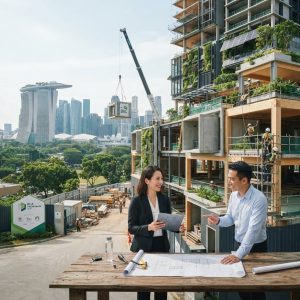


Building the Future: Trends Shaping Singapore’s Construction Industry in 2026
The Singapore construction industry trends 2026 reflect a transformative era marked by rapid technological integration and a steadfast commitment to environmental sustainability. As the nation accelerates toward its ambitious climate goals, the built environment is undergoing a radical shift, moving away from conventional practices toward smarter, greener, and more efficient methodologies. Construction stakeholders, from urban planners to contractors, are currently prioritizing low-carbon building materials, automated construction workflows, and high-performance structural designs that align with the nation’s long-term infrastructure roadmap. This pivot is not merely a response to global regulatory pressures but a strategic necessity in a dense urban landscape where resources are finite and efficiency is paramount. By embracing modern construction methods such as prefabricated pre-finished volumetric construction and advanced digital twin technology, Singapore continues to maintain its global reputation as a pioneer in urban development. This article explores how these emerging trends are redefining the landscape, ensuring that the local industry remains resilient, highly competitive, and environmentally responsible while navigating the complexities of an evolving global market throughout the remainder of the decade and well beyond.
Table of Contents
Digital Transformation and Smart Construction
In 2026, the integration of digital technology has evolved from a competitive advantage into a baseline requirement for any major project within the Singapore construction industry. Central to this evolution is the widespread adoption of Building Information Modeling, which has matured into a sophisticated ecosystem where real-time data informs every stage of the design and build process. Industry experts now rely on advanced digital twins to simulate complex building interactions, allowing teams to predict energy consumption patterns, structural stress points, and potential maintenance requirements long before ground is broken. This predictive capability significantly reduces the likelihood of costly errors during the construction phase, saving both time and financial resources. Furthermore, the use of Internet of Things sensors embedded within site equipment and structural elements has revolutionized the way contractors monitor safety and project timelines. These smart systems provide a granular view of site activities, offering real-time updates that enable project managers to make data-driven decisions on the fly. The deployment of autonomous machinery and drone-based surveying has also become standard practice, particularly for large-scale infrastructure projects that require frequent, precise monitoring of site topography. By centralizing documentation through cloud-based platforms, all stakeholders—from architects to site supervisors—stay aligned with the latest blueprints, which eliminates the fragmentation often seen in traditional workflows. The move toward a paperless construction site is not just about environmental efficiency; it is about creating a transparent, highly accountable environment where information is accessible, accurate, and actionable. As these technologies mature, they foster a culture of innovation that pushes the boundaries of architectural feasibility, enabling the construction of smarter, more resilient infrastructure that meets the needs of a densely populated urban society while simultaneously optimizing operational costs for long-term ownership.
The Rise of Sustainable and Low-Carbon Practices
Sustainability has become the cornerstone of development in the Singapore construction industry trends 2026, driven by an urgent need to reduce the carbon footprint of the entire sector. With the building sector contributing significantly to national energy demand, there is a laser-focused initiative to mandate low-carbon building materials across all new developments. Engineers and procurement teams are increasingly opting for green cement, recycled steel, and mass-engineered timber, which drastically lower the embodied carbon compared to traditional high-impact alternatives. These material choices are supported by a rigorous certification landscape that ensures buildings are not only energy-efficient during their operation but also ecologically responsible from the moment raw materials are sourced. Design trends now favor passive cooling strategies, which leverage Singapore’s unique geographic position to reduce reliance on artificial climate control systems. This includes the strategic use of high-performance glazing, green facades, and natural ventilation systems that circulate air through building cores. Beyond the physical structure, the operational lifecycle of a building is being monitored through advanced building management systems that utilize artificial intelligence to optimize electricity and water usage. By integrating renewable energy generation, such as building-integrated photovoltaics, structures are being designed to act as micro-power plants. This shift is essential for meeting the nation’s 2030 green plan, which emphasizes the need for more energy-efficient buildings and a significant reduction in waste generated during the build process. Table 1 below highlights some of the key shifts in material usage within the current market environment. By fostering a circular economy where construction materials are repurposed and building performance is constantly audited against sustainability benchmarks, the local industry is successfully aligning its commercial objectives with essential environmental preservation goals.
| Metric | 2020 Standard | 2026 Trend |
|---|---|---|
| Embodied Carbon Target | Moderate Reduction | Strict Low-Carbon Mandatory |
| Digital Adoption | Manual/Basic CAD | Advanced AI/Digital Twin |
| Material Preference | Traditional Concrete | Green Cement/Timber |
| Waste Management | Site-level disposal | Circular/Recycled Focus |
Modern Methods of Construction and Prefabrication
The push for enhanced productivity has solidified the adoption of Modern Methods of Construction as the industry standard in 2026. Prefabricated Pre-finished Volumetric Construction has emerged as the most efficient way to maintain project timelines in a labor-constrained environment. By producing fully finished modules in controlled, high-precision off-site factories, companies can reduce site disruptions, enhance structural quality control, and decrease the number of personnel required on the actual building plot. This approach minimizes noise pollution and site waste, which are critical concerns in Singapore’s tight urban residential areas. Furthermore, the precision afforded by factory-controlled environments ensures that each module fits perfectly, leading to faster assembly times and superior structural integrity. This modular approach is being scaled from simple residential housing to complex commercial and industrial developments, showcasing the versatility of modern engineering. Beyond prefabrication, the shift toward design-for-manufacturing-and-assembly (DfMA) has forced designers to rethink how buildings are conceptualized from the start. Instead of treating buildings as artisanal projects built from scratch, they are now viewed as assemblies of optimized, high-performance parts. This shift necessitates earlier collaboration between contractors and architects, fostering an integrated design process where constructability is prioritized from the initial sketch. The benefits of this transition are clear: shorter project delivery times, reduced dependency on site-based physical labor, and higher safety standards for staff who work in safer, more ergonomic factory conditions. This industrialization of the construction sector is effectively insulating the industry against supply chain volatility while providing the scale necessary to meet the nation’s ongoing infrastructure requirements. The long-term impact of this shift is a more resilient, technology-driven sector that can scale capacity without compromising quality or safety standards.
Workforce Evolution and Industry Resilience
As the sector modernizes, the workforce supporting the Singapore construction industry trends 2026 is also undergoing a profound evolution. There is a palpable shift toward a more highly skilled, technology-literate talent pool capable of managing automated machinery and complex digital platforms. The traditional reliance on manual, labor-intensive roles is rapidly being replaced by positions that require technical certifications in Building Information Modeling, drone piloting, and automated system maintenance. This transition is not merely replacing people with machines; it is elevating the nature of work, offering better career prospects and higher safety standards for professionals entering the industry. Educational institutions and industry bodies are collaborating closely to provide reskilling programs, ensuring that current employees remain relevant in an environment where technical agility is key. The emphasis on worker safety has also reached new heights, with wearable technology now providing real-time data on employee health, environmental hazards, and site accidents. This data-centric approach to workforce management prevents injuries and ensures that labor resources are deployed where they are most effective. Furthermore, the culture of construction is becoming more inclusive and collaborative, with project teams increasingly adopting agile project management techniques. This horizontal management structure empowers individual teams to solve technical challenges locally, reducing bottlenecks and fostering innovation at the ground level. As the industry continues to prioritize digital literacy and advanced mechanical skills, the perception of construction as a career path is shifting, attracting younger, tech-savvy professionals who see the industry as a hub for high-tech engineering and environmental stewardship. By investing in the long-term professional development of the local workforce, the Singaporean construction sector ensures that it remains resilient against future labor challenges and keeps pace with global technological advancements.
In conclusion, the Singapore construction industry is currently navigating an exciting period of maturation where technology and sustainability are the twin engines of progress. The trends identified throughout 2026—ranging from the widespread adoption of digital twins and modular prefabrication to the stringent focus on low-carbon materials—demonstrate a mature sector that is ready for the future. By embracing these innovative methodologies, companies are not only ensuring operational efficiency but are also contributing to the national imperative of creating a resilient, high-quality, and environmentally sustainable urban landscape. As these practices become further embedded into the fabric of the industry, we can expect continued growth and a strengthening of Singapore’s global standing as a leader in modern building practices. The commitment to these advancements will ensure that the built environment remains durable, efficient, and aligned with the evolving needs of the citizens it serves.
常见问题
What are the primary drivers of Singapore construction industry trends 2026?
The primary drivers include national climate change initiatives, the need for increased construction productivity, and the adoption of digital technologies to mitigate labor constraints.
How is prefabrication changing the local building landscape?
Prefabricated methods reduce site noise, waste, and physical labor requirements while ensuring higher quality control and faster project delivery through precision-engineered modular components.
What role does digital technology play in new construction projects?
Digital technologies like Building Information Modeling and digital twins allow for precise project simulations, predictive maintenance, and real-time data management for increased efficiency.
Are low-carbon materials becoming mandatory for developers?
Yes, there is an industry-wide shift toward using green building materials, including low-carbon cement and mass-engineered timber, to meet strict national sustainability and carbon-reduction targets.
How is the construction workforce adapting to these changes?
The workforce is focusing on upskilling in digital literacy, automated machine operation, and sophisticated project management to handle the modern technological demands of the industry.